
NDG has worked closely with the Cisco CCNP lab team to develop NETLAB+ compatible labs for ONT.
ONT is supported by one or more of the following NETLAB+ pods:
The supported lab list (below) provides a list of ONT compatible labs and the pod types that can be used for each lab.
The routers used must meet minimum IOS requirements specified by the curriculum. The following recommendations are based on the CCNP 5.0 Equipment List (available on Academy Connection).
| Router | Recommended Model(s) |
Minimum IOS + Feature Set |
|---|---|---|
| R1 | Cisco 2811 Cisco 2801 |
IP Voice Image 12.4(9)T1 + Unified Call Manager Express (CME) 4.0(2)1 |
| R2 |
Cisco 2811 Cisco 2801 Cisco 1841 |
ISR Advanced IP Services K9 IOS (S28NAISK9-12410) ISR Advanced IP Services K9 IOS (S280AISK9-12410) Advanced IP Services K9 IOS (S184AISK9-12410) |
| R3 |
Cisco 2811 Cisco 2801 Cisco 1841 |
ISR Advanced IP Services K9 IOS (S28NAISK9-12410) ISR Advanced IP Services K9 IOS (S280AISK9-12410) Advanced IP Services K9 IOS (S184AISK9-12410) |
| R4 |
Cisco 2801 Cisco 2621 |
IPBASE + Pagent2 special download |
1The ONT lab 2.1 uses an IP Voice Image 12.4(9)T1 with Cisco Unified Call Manager Express (CME) 4.0(2).
2Pagent is necessary in order to complete the ONT labs and must be running on R4. Pagent is a special IOS image and download. For more information see below.
To enable the ONT labs, check the box for "AE CCNP ONT V5.0 English" in the class settings. This must be done for each class requiring access to ONT labs. You may also allow the class to make "pod-only" reservations using the ONT pod types listed above. To enable pod-only reservations, select the check boxes for the following options in the class settings that are appropriate for the pods available on your system:
These reservations are not tied to specific lab exercises. Therefore, the pod will be configured using the default network configuration. Please note however, not all ONT use the default network configuration and must be completed by selecting the correct lab exercise (see the following discussion).
Always select the correct lab exercise for the lab being performed. Students or teams should schedule the correct lab exercise from the catalog. NETLAB+ will only show those labs for which the required pod type is available. A lab that works on different pod types may appear more than once if your system is so equipped. Instructors should select the correct lab from the Exercise tab during instructor-led lab reservations. This can be done as many times as needed during the reservation.
Importance of Choosing the Correct Lab Exercise
Several of the labs may differ from the standard pod topologies. This is
handled by NETLAB+ Dynamic VLAN Mapping technology. Always select the
correct lab exercise for the actual lab. This insures that NETLAB+
will set up VLANs on the control switch such that lab devices and PCs are
placed in the correct LAN segment for the exercise being performed. Selecting
the correct exercise will also make the completed lab output easier to find in
the archive.
| Lab | Description | Pod Required | Comments |
|---|---|---|---|
| 2.1 | Configure CME using the CLI and Cisco IP Communicator | CRP or BRPv2 | Please see the list of required software. |
| 3.1 | Preparing for QoS | CRP or BRPv2 | Traffic should be injected. Pagent is recommended. |
| 3.2 | Installing SDM | CRP or BRPv2 | Please see the list of required software. |
| 3.3 | Configuring QoS with SDM | CRP | Traffic should be injected. Pagent is recommended. |
| 4.1 | Default Queuing Tools | CRP | |
| 4.2 | Intermediate Queuing Tools | CRP | Traffic should be injected. Pagent is recommended. |
| 4.3 | TCP Header Compression | CRP, BRPv2, or BRPv1 | |
| 4.4 | Comparing Queuing Strategies | CRP | Traffic should be injected. Pagent is recommended. |
| 4.5 | Class-based Queuing and NBAR | CRP | Traffic should be injected. Pagent is recommended. |
| 4.6 | Class-based Marking, shaping, and Policing | CRP | Traffic should be injected. Pagent is recommended. |
| 4.7 | WAN QoS Tools | CRP | Traffic should be injected. Pagent is recommended. |
| 4.8 | Shaping and Policing | CRP | Traffic should be injected. Pagent is recommended. |
| 4.9 | QoS Pre-classify | CRP | Traffic should be injected. Pagent is recommended. |
| 5.1 | AutoQoS | CRP | Traffic should be injected. Pagent is recommended. |
| Case Study | QoS and MLPPP | CRP | Traffic should be injected. Pagent is recommended. |
The following labs are not currently included in the ONT distribution. They are planned as a future update in conjunction with the CSP+W pod type. NDG is researching the feasibility of this planned topology.
| Lab | Description | Pod Required | Comments |
|---|---|---|---|
| 6.1a | Configuring a WLAN Controller | CSP+W | Requires external Wireless Lan Controller (WLC) |
| 6.2a | Configuring a WLAN Controller via the Web Interface | CSP+W | Requires external Wireless Lan Controller (WLC) |
| 6.3 | Configuring a Wireless Client | CSP+W | |
| 6.4 | Configuring WPA Security with Preshared Keys | CSP+W | |
| 6.5 | Configuring LEAP | CSP+W |
The following list documents the required software for ONT.
| Software Name | Purpose | Requirements | Comments / Links |
|---|---|---|---|
| IOS IP Voice 12.4(9)T1 with CME 4.02 | Required for Lab 2.1 | The router must have a certain amount of DRAM and Flash. | www.cisco.com |
| Cisco IP Communicator (CIPC) | The SDM is installed onto the router's flash memory or in the PCs. |
Supported Microsoft Windows O/S:
|
This software is used to make phone calls, and should be
installed on PC1a and PC1b. www.cisco.com |
| Secure Device Manager (SDM) | The SDM is installed onto the router's flash memory or in the PCs. |
Supported Microsoft Windows O/S:
|
For using SDM, the web browser requires SUN JRE 1.4 or later and
ActiveX control must be enabled. www.cisco.com |
The ONT Quality of Service (QoS) labs use Pagent's TGN traffic generation tools. Pagent generates realistic traffic and bottlenecks to test QoS features such as IP Classification, IP Marking, and Queuing.
Pagent is an enhanced Cisco IOS image that contains both Advanced IP or IP Base Services and the IP traffic generation tools. This image is loaded on router R4 in the Cuatro Router Pod. Routers R1, R2, and R3 run normal IOS images.
Pagent was developed within Cisco primarily intended for Cisco internal use only. However, versions for the 2621 and 2801 have been made available to CCNP Academies and instructors by special permission from Cisco's Pagent group.
The ONT labs utilize Pagent in two different logical topologies: Basic and Advanced. Lab 3.1 (Preparing for QoS) explains the differences and general configuration tasks for each.
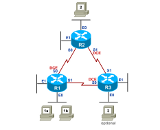
Refer to the image to the right. Traffic sourced from R4 (TrafGen) Fa0/0 is destined for R4 Fa0/1. This traffic traverses the depicted topology from end-to-end so that you can observe bottlenecks. Along the way, traffic may need to pass over Ethernet VLANs or point-to-point serial links before arriving back at R4.
ONT Lab 3.1 provides Pagent configurations for router R4 that can be loaded at the beginning of each lab. You may use use the NETLAB+ file manager and load tab to automate this process.
ONT Lab 3.1 figure 2-1 illustrates the general description of the Basic Pagent Configuration. Figure 2-2 illustrates how the Basic Pagent Configuration could be applied in a single-router network topology.
Special care must be taken when using NETLAB+
An alternate configuration for NETLAB+ is provided in ONT
Lab 3.1, page 17, Appendix C, NETLAB Compatible Advanced Pagent
Configurations. This configuration differs slightly from the
regular steps. The explanation below applies only to NETLAB+.
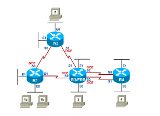
Refer to the diagram to the right. Both a primary and secondary IP address are bound to interface Fa0/0 on router R4 (without using subinterfaces). Traffic generated from the R4 Fa0/0 secondary IP address is destined for the primary IP address on the same interface (Fa0/0). This traffic traverses the topology from end-to-end so that you can observe bottlenecks. Along the way, traffic may need to pass over Ethernet VLANs or point-to-point serial links before arriving back at R4.
ONT Lab 3.1 provides Pagent configurations for router R4 that can be loaded at the beginning of each lab. You may use use the NETLAB+ file manager and load tab to automate this process.
ONT Lab 3.1 figure 5-1 illustrates the general description of the Advanced Pagent Configuration. Figure 5-2 illustrates conceptually how the Advanced Pagent Configuration works. Appendix C, NETLAB Compatible Advanced Pagent Configurations, provides the router configuration templates when using NETLAB+.
NETLAB version 4.0.23 and later supports automation of Pagent images. Pagent images are uploaded to the NETLAB+ server and assigned to routers in the same manner as ordinary IOS images. The administrator must also provide NETLAB+ with the license key for each router running Pagent. Once this process is completed, NETLAB+ will automatically enter the required activation key for Pagent. Having this task automated by NETLAB+ eliminates the need to enter this key with each use.
The process for loading and using Pagent with NETLAB+ differs slightly from normal IOS.
Please refer to Appendix B of the NETLAB+ Administrator Guide for step-by-step instructions.